If you suspect poisoning, contact Tox Info Suisse

24-hour emergency number Tel 145

(from abroad: +41 44 251 51 51)

Advice, Research, Education and Training in Established and Emerging Methodologies in Human Toxicology

Our Mission

Our Mission

The Swiss Centre for Applied Human Toxicology (SCAHT) is a national competence centre and research infrastructure for regulatory toxicology based in Basel.

Our mission is to protect human health and contribute to a safer and healthier environment by advancing the science of human toxicology and translating it for regulatory use to benefit society. To reach this goal, the SCAHT promotes regulatory science, provides scientific expertise to regulatory toxicology and bridges between researchers and regulators. Complex research is translated into practical recommendations, measures and policies covering risk assessment, management and communciation.

About Us

The SCAHT team brings together experts dedicated to advancing human-relevant approaches in toxicology and risk assessment through interdisciplinary research, education, and collaboration. The centre is directed by Prof. Dr. med. Ellen Fritsche, an internationally recognised expert in developmental neurotoxicity and new approach methodologies.

You can find the full list of team members and their profiles here.
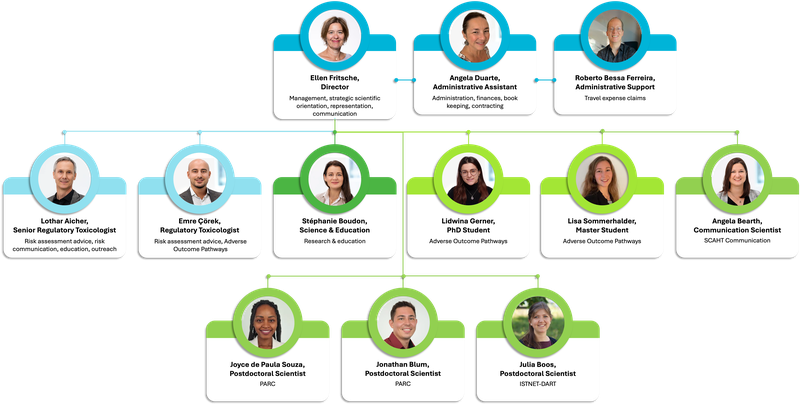
Team SCAHT

As a Swiss Article 15 Institution, SCAHT is funded by the Swiss Confederation supported by the Universities of Basel, Geneva, Lausanne and the FHNW School of Life Sciences. It collaborates closely with Swiss and international higher education and research institutions, the Swiss Centre for Applied Ecotoxicology (Ecotox Centre) and the national and cantonal as well as international authorities like the Federal Office for Public Health (FOPH), the Federal Food Safety and Veterinary Office (FSVO), the European Food Safety Authority (EFSA) and the European Chemicals Agency (ECHA).

More information can be found here:

Foundation Council

Management Board and Directorate

Research Group Leader Committee
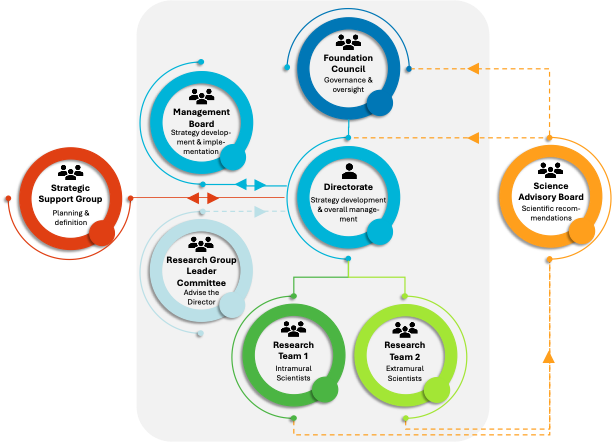
Science Advisory Board

Auditors

SCAHT Organisational Chart

Following an application by Prof. Denis Hochstrasser (University of Geneva) and Prof. Stephan Krähenbühl (University of Basel), the SCAHT was founded in 2009 to address gaps in applied toxicology research, consultation services, and training in Switzerland after the closure of the Swiss Institute of Toxicology. Financial support was provided by the Swiss Confederation with in-kind contributions from the Universities of Basel, Geneva and Lausanne.

In its first funding period (2009-2012), SCAHT consolidated its role as a national hub for human toxicology and risk assessment and strengthened Swiss presence in international toxicology under the founding Director Prof. Martin Wilks. In 2012, it was decided to form a foundation hosted by the University of Geneva, which was officially registered in 2014. SCAHT celebrated its 10-year anniversary in 2019, and in 2020 the FHNW School of Life Sciences joined as a partner organisation.

Under the new director Prof. Ellen Fritsche, the centre continues to expand its national and international research networks, education programmes, and its contributions to regulatory toxicology. Particularly, SCAHT is committed to bring the newest developments in toxicology into regulatory practice.

Job listings

The Swiss Center for Applied Human Toxicology (SCAHT), affiliated with the University of Basel, is seeking a highly motivated postdoctoral researcher in digital and computational toxicology to strengthen the SCAHT’s activities in the field of the digital transformation of human and regulatory toxicology, with a view to next-generation risk assessment. We are seeking a scientist with a strong background in toxicology and expertise in computational toxicology, data science, artificial intelligence, and data governance. Ideally, the candidate will have experience in applied sciences or a keen interest in applying their experience to address applied research objectives and challenges. The successful candidate will contribute to the development of innovative digital infrastructures, computational workflows, and AI-based tools designed to support the national and international toxicology community.Application deadline: August 16

Contract start date: to be agreed upon

Your responsibilities

  • Develop and implement data management strategies, standards, and plans that comply with FAIR principles.
  • Build, organize, and maintain toxicological datasets and digital knowledge resources using public databases, scientific literature, “omics” datasets, and regulatory resources.
  • Develop and apply computational methods to analyze, integrate, and visualize complex toxicological datasets.
  • Evaluate, implement, and refine AI- and machine learning-based approaches for data organization, analysis, and knowledge extraction.
  • Develop and integrate Adverse Outcome Pathways (AOPs) and other mechanistic knowledge frameworks to support biology-based risk assessment.
  • Contribute to national and international collaborative research projects as well as grant proposals.
  • Publish scientific findings in leading peer-reviewed journals and present findings at international conferences.
  • Support training activities, knowledge transfer, and collaboration within academic, regulatory, and industrial communities.

Duration:

  • 2 years, with the possibility of extension.

Your Profile

  • We invite highly motivated researchers with a strong background and a passion for computational and data-driven toxicology to apply.

Required Qualifications

  • Ph.D. in toxicology, computational toxicology, data science, bioinformatics, computational biology, or a related field.
  • Proven experience in toxicology, or a strong interest in applying computational methods to toxicological research.
  • Experience in computational data analysis using Python and/or R, including the management, cleaning, and integration of large biological or toxicological datasets.
  • Experience in the management, cleaning, and integration of large biological or toxicological datasets.
  • Knowledge of database management, FAIR data principles, and data governance.
  • Excellent analytical and problem-solving skills.
  • Excellent command of written and spoken English, as well as strong communication skills.

Desired Qualifications

  • Experience in machine learning, artificial intelligence, and/or natural language processing.
  • Experience in reproducible computational research using tools such as Git, Docker, and workflow management systems.
  • Knowledge of public toxicological databases (e.g., AOP-Wiki, ToxCast, PubChem, or ChEMBL).
  • Proven experience in scientific publishing.
  • Knowledge of German and/or French.

We offer

  • Joining the SCAHT means becoming part of an internationally renowned center dedicated to advancing human-centered toxicology and next-generation risk assessment. You will work in a highly interdisciplinary environment at the intersection of toxicology, data science, and regulatory science, with the opportunity to contribute to the digital transformation of toxicology in Switzerland and Europe.
  • The opportunity to shape the emerging field of digital toxicology.
  • A collaborative, internationally renowned research environment.
  • Close collaboration with academic, industrial, and regulatory partners at the national and international levels.
  • Access to state-of-the-art research infrastructure in computer science, artificial intelligence, and toxicology.
  • Opportunities to develop innovative digital solutions supporting the regulatory implementation of “New Approach” (NAM) methodologies.
  • Excellent opportunities for scientific and professional career development.
  • Flexible working conditions and a position in Basel, Switzerland, in accordance with the terms and conditions of the University of Basel.

Application / Contact:Please submit your application as a single PDF file containing your cover letter, resume, and professional background via email to angela.duarte@unibas.ch. For more information, please visit our website at scaht.org and/or contact our scientific coordinator,

Dr. Stéphanie Boudon, by email at stephanie.boudon@unibas.ch or

Dr. Lothar Aicher by email at lothar.aicher@unibas.ch

The regulatory toxicologists at the SCAHT provides scientific expertise to support authorities in their risk assessment, management and communication activities. The Centre provides a link between researchers and regulators, helping to translate complex research findings into practical recommendations, measures and policies. SCAHT contributes to the regulatory use of established and new methods, such as in vivo, in vitro and in silico approaches, to tackle new challenges and generate human-relevant and mechanistic insights. SCAHT works in close collaboration with Swiss national authorities as well as leading international bodies such as the European Food Safety Authority (EFSA) and the European Chemicals Agency (ECHA). Recent activities include active participation in the European Commission’s Human Health Working Group, contributing to the development of the European roadmap towards phasing out animal testing for chemical safety assessment.

The SCAHT’s regulatory toxicology research aims at filling an existing gap in Switzerland between academic scientific research and regulatory requirements addressing major human health problems of regulatory concern. It is structured into two complementary components: intramural integrative desktop research carried out within the SCAHT directorate in Basel, which focusses on data integration, mechanistic interpretation, regulatory translation, and strategic programme development. Second, the extramural, experimental wet-lab research, which is conducted by Swiss SCAHT partner institutions through targeted funding within a framework of a coordinated, 4-year research programme.

SCAHT’s education and training programme is designed to meet the diverse needs of graduate and continuing education for academia, regulatory agencies and industry. This includes the coordination of modules within the MSc Drug Science in Basel and the MAS Toxicology in Geneva, training for Swiss authorities and international actors. It also leads outreach initiatives to foster dialogue among scientists, regulators and the public.